
PQChips 2026 August
PQChips 2026 August – 24–28 August 2026 – University of Gdańsk, Gdańsk, Poland
What is the workshop about?
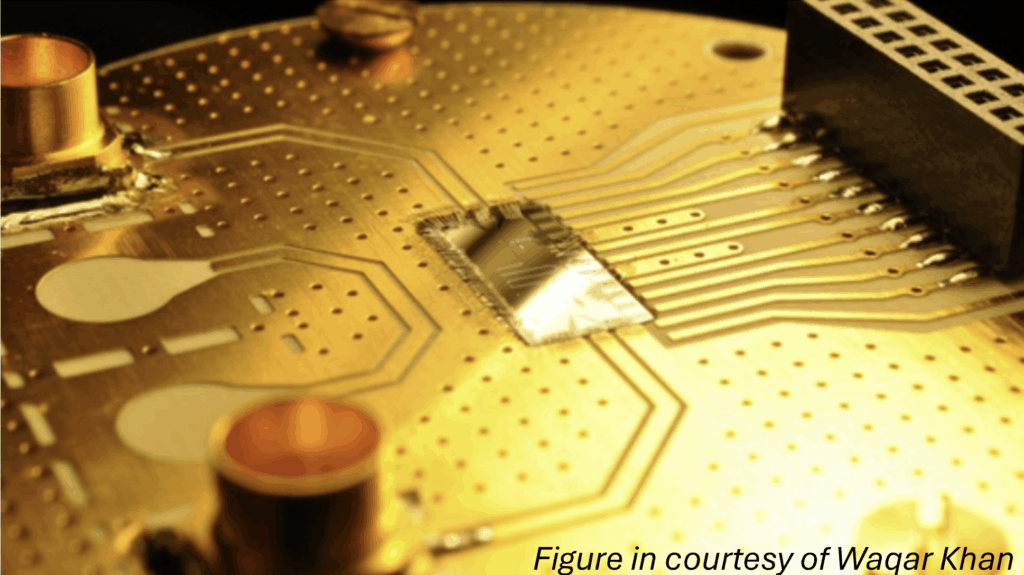
Quantum chips provide a rapidly developing platform for exploring fundamental quantum phenomena and implementing emerging quantum technologies. Their physics brings together condensed-matter physics, mesoscopic transport, quantum optics, topology, superconducting and semiconductor devices, and quantum information science.
The Workshop on Physics of Quantum Chips (PQC 2026) will introduce participants to the physical principles, theoretical methods, and experimental concepts underlying modern chip-based quantum systems. The programme will connect foundational phenomena—such as geometric phases, quantum interference, the quantum Hall effect, and topological states of matter—with current developments in nonequilibrium quantum transport, circuit quantum electrodynamics, nonlinear and nonreciprocal devices, nanoscale modelling, and quantum algorithms.
Particular attention will be given to the ways in which charge, energy, photons, and quantum information are generated, transported, manipulated, and measured in nanoscale and on-chip quantum platforms. The lectures will combine conceptual foundations with analytical and computational methods relevant to contemporary research.
The lectures will emphasize physical understanding while also introducing analytical and computational methods relevant to current research.
ECTS Information
The workshop is associated with 1 ECTS point and participance will be attested by a certificate.
Upon successful participation in the workshop, the participant is able to:
– demonstrate advanced understanding of geometric, topological, and nonequilibrium transport phenomena;
– explain the physical principles of superconducting qubits and quantum photonic integrated circuits;
– interpret experimental concepts and measurement techniques relevant to superconducting and photonic quantum-chip platforms;
– utilize nonequilibrium Green’s-function formalism in description of nanoscale systems
– critically discuss current research problems related to quantum chips, mesoscopic physics and quantum technologies;
– communicate scientific ideas and research results clearly in an international academic environment;
– engage in scientific discussion, poster-session exchange and constructive feedback with peers and lecturers;
– independently expand knowledge in the rapidly developing field of quantum devices and quantum-chip technologies.
Main topics
The scientific programme will include:
- Berry phases and their role in quantum transport
- The Aharonov–Bohm effect and quantum interference
- Quantization of the Hall conductance
- Models of the quantum Hall effect and topological insulators
- Topological states of matter and their on-chip simulation
- Nonequilibrium Green’s-function methods for nanoscale systems
- Transient and steady-state transport in interacting quantum systems
- Nonlinearity and nonreciprocity in quantum technologies
- Ultrastrong-coupling circuit-QED physics
- Algebraic approaches to quantum algorithms
Further lecture themes will be added when the remaining lecture titles are finalized.
Workshop format
PQChips 2026 August is organized around extended lecture series rather than short conference presentations.
Lecturers will deliver coherent mini-courses consisting of up to three 90-minute sessions. This format will allow the lecturers to introduce the foundations of their subjects, explain the principal theoretical or experimental methods, and discuss selected current research directions and applications.
No more than three 90-minute sessions will be scheduled on any given day. The programme is designed to provide sufficient time for questions, scientific discussions, and interaction between lecturers and participants.
- mesoscopic and condensed-matter physics;
- nanoscale and nonequilibrium quantum transport;
- quantum information and quantum technologies;
- superconducting and semiconductor quantum devices;
- quantum optics and circuit QED;
- topological phases of matter;
- quantum materials and nanostructures.
Participants should have a basic understanding of quantum mechanics. Previous knowledge of solid-state physics, quantum optics, statistical mechanics, or quantum information will be helpful, but expertise in all the subjects covered by the workshop is not required.
In particular, the workshop may be valuable for:
- Researchers in condensed-matter and mesoscopic physics who wish to deepen their understanding of geometric, topological, and nonequilibrium transport phenomena.
- Researchers in quantum information and quantum thermodynamics who are interested in the physical implementation of quantum technologies in solid-state and circuit-based platforms.
- Experimental researchers working with nanostructures, quantum materials, superconducting circuits, or quantum-optical devices who wish to explore complementary theoretical approaches.
- Theoretical researchers interested in connecting analytical and computational methods with experimentally accessible nanoscale systems.
Deadlines
- Registration opening: 13.07.2026
- Registration deadline: 18.08.2026
- Notification of acceptance: by 19.08.2026

Our Sponsors and Partners: